 Juicefinance
 First Lending Deposit and Pool Selection
Juicefinance’s first lending deposit starts with an available USDB or WETH pool on Blast and a review of its withdrawal liquidity. The Lend flow separates token approval from Supply. Borrowing demand changes the interest rate, while heavily used pools can delay access to deposited assets.
A confirmed lending deposit remains subject to pool liquidity constraints until withdrawal returns the supplied assets to the wallet.
USDB and WETH Lending Pools
USDB and WETH lending pools provide the assets that collateral-backed borrowers use, so a first deposit selects a source of lending liquidity. The pool holds the supplied asset and lends it through the protocol. Borrower credit accounts handle the resulting loans and strategy positions. Interest returns to the lending pool, which allocates income among lenders in proportion to their supplied liquidity. This connects a passive deposit to borrowing demand without making the depositor responsible for managing a borrower account.
Strategy vaults deploy borrowed funds into other protocols. A plain lending deposit does not require choosing a vault or managing a leveraged position.
Blast Balances and Transaction Funding
USDB or WETH must be available in the supplying wallet on Blast before the corresponding lending-pool transaction can succeed. A balance with the same ticker on another network does not fund that transaction. Confirm the wallet’s selected network and the asset that the pool accepts before entering the supply amount. A wallet-funded lending deposit also requires native ETH for gas. USDB and WETH serve as lending assets, separate from that native transaction-fee balance.
The selected pool must also accept new supply. A displayed token balance does not establish deposit availability, and an old rate does not describe the pool’s present conditions. If the application cannot present the intended pool, asset, and supply amount for wallet review, stop before authorization. This leaves the proposed lending funds outside the pool while the readiness issue remains unresolved.
Approval Amount and Supply Authorization
An approval authorizes the lending contract to spend a chosen token amount, and it precedes Supply in the Lend procedure. The wallet request should identify the lending token and the spending allowance. Review those details against the selected pool before granting permission. An authorization for WETH differs from one for USDB, even when both assets appear in the interface. Permission for one token does not cover the other asset.
Approval grants permission without creating a lending position. Stopping after approval leaves the intended supply amount outside the pool.
An allowance larger than the intended deposit grants permission over more tokens than that deposit requires. The spending limit therefore deserves attention independently of the supply amount. Stopping before Supply does not undo an approval that already confirmed. That permission can remain relevant after the first session ends, even if the session creates no lending position. Keep the authorization record separate from the deposit record when checking what the wallet has actually done.
Supply moves the selected asset into the pool after the approval confirms. Keep the asset consistent through that sequence. A pending approval does not satisfy the prerequisite for the deposit.
Variable Interest and Lending Service Fees
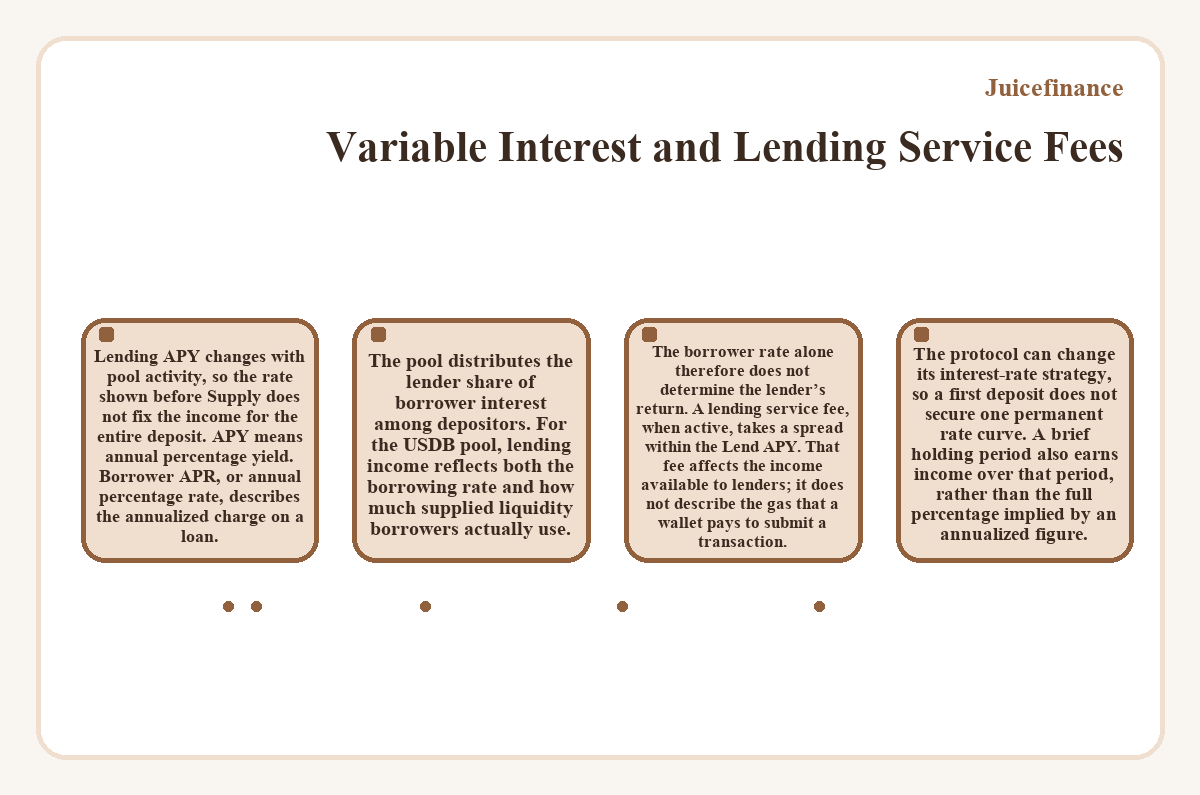
Lending APY changes with pool activity, so the rate shown before Supply does not fix the income for the entire deposit. APY means annual percentage yield. Borrower APR, or annual percentage rate, describes the annualized charge on a loan. The pool distributes the lender share of borrower interest among depositors. For the USDB pool, lending income reflects both the borrowing rate and how much supplied liquidity borrowers actually use. The borrower rate alone therefore does not determine the lender’s return.
A lending service fee, when active, takes a spread within the Lend APY. That fee affects the income available to lenders; it does not describe the gas that a wallet pays to submit a transaction. The protocol can change its interest-rate strategy, so a first deposit does not secure one permanent rate curve. A brief holding period also earns income over that period, rather than the full percentage implied by an annualized figure.
Pool Utilization and Accessible Liquidity
Pool utilization measures how much lending liquidity borrowers use, connecting interest-rate behavior with the assets available for lender withdrawals. At a given pool size, more borrowing leaves a smaller unused balance. The rate model links borrowing costs to utilization and raises them more sharply beyond its configured optimal level. High pool utilization can delay lender withdrawals. A pool can therefore show an income-bearing lending position while borrowers hold much of the underlying liquidity. Total supplied assets and immediately accessible assets answer different questions.
A higher variable rate can accompany tighter withdrawal liquidity. Income and immediate access therefore need separate consideration when selecting the first pool.
Supply Confirmation and Lender Accounting
A successful Supply transaction and its corresponding lender position confirm a deposit; a submitted transaction alone leaves the outcome unresolved. Match the confirmed transaction to the selected wallet, asset, and pool. An approval confirmation concerns permission, while a successful supply concerns deposited liquidity. If the transaction outcome remains unclear, resolve that state before submitting another deposit. Check the asset and amount represented by the lender position.
The USDB pool uses liquidity-token accounting to represent a lender’s claim on underlying assets. Its accounting incorporates accrued pool income, so that claim can grow without another Supply transaction. This explains why a lender position can differ from the original deposit amount after income accrues. The claim belongs to the lending position; the wallet balance of USDB that remains outside the pool describes different holdings. Keep those balances distinct when reconciling the first supply.
Blast Yield and Earlier Campaign Rewards
Blast native yield contributes to the lending model separately from borrower interest, while earlier points campaigns added a different kind of incentive. The lending pool configures native yield as claimable. For USDB, the pool accounts for claimed yield through its lender income calculation. Idle USDB in the pool and USDB yield forwarded from a strategy can contribute to that accounting. The claimable yield belongs to the pool’s income accounting; it does not require the lender to treat each yield claim as a fresh deposit.
Blast points and Blast Gold belonged to earlier airdrop phases. Blast retired the Points API and ended new points and Gold accrual under its replacement reward system. Historical point formulas therefore do not describe new rewards from a first lending deposit. JUICE points belong to a separate program with its own eligibility and accrual rules. A points tally is separate from the USDB or WETH that a lending position represents.
Passive Lending and Capital Risk
Lenders can lose capital when collateral recovery cannot cover borrower debt, even though a plain lending deposit carries no personal loan. Borrowers post collateral, and liquidation aims to repay the lending pool when their positions breach margin requirements. The proceeds can fall short of the amount owed. That shortfall creates bad debt, and lenders can bear losses in proportion to their participation. Passive lending removes the task of managing a personal leveraged account; it still exposes the supplied capital to the pool’s lending outcomes.
A lending deposit uses one asset and avoids the impermanent loss associated with a trading pair. That specific distinction does not protect deposited funds from software faults, exploits, or insufficient debt recovery. A protocol malfunction or security breach can cause partial or complete loss. For a first deposit, these mechanisms explain the exposure that begins when Supply succeeds. Watching the displayed income alone does not reveal whether the pool’s assets remain fully recoverable.
Lending Supply and Borrowing Collateral
WETH supplied to the lending pool earns lender income; WETH posted as collateral supports borrowing and creates a different position. The same asset appears in both roles, so the selected operation determines its purpose. A lending deposit does not create borrowing capacity against that deposited asset. USDB pool lending supports the route that uses WETH collateral for USDB loans. WETH pool lending supports borrowing against LRT collateral. An LRT is a liquid restaking token; its collateral role does not make it the WETH asset that a lender supplies.
Can I Withdraw My Lending Deposit Immediately?
A lender can withdraw when the pool has enough available liquidity to meet the requested amount. The Lend interface switches between Supply and Withdraw, with Withdraw taking an amount against the lender position. Pool utilization can restrict access even when that position still shows a balance. A withdrawal control does not promise immediate liquidity. The relevant condition concerns the assets that the pool can return when the transaction executes.
Lender withdrawal and borrower collateral withdrawal have different prerequisites. A plain lender has no personal USDB loan to repay or vault position to unwind as part of removing lending liquidity. Those obligations belong to borrowing accounts. Pool liquidity can still prevent an immediate exit, and the lending model supplies no fixed waiting period for every utilization state. If access at a specific time matters, that uncertainty belongs in the deposit decision before authorization.
First Supply Decision
A first Supply can end with a lender position, leaving borrowing and vault selection outside that session.
- Choose the USDB or WETH pool that matches the asset already available in the wallet on Blast.
- Retain native ETH for transaction fees, separate from the amount intended for the lending pool.
- Review the variable Lend APY and any active lending service spread before granting token permission.
- Allow for withdrawal delays if borrowers use most of the pool’s supplied liquidity.
- Confirm approval before Supply, then reconcile the successful deposit with the corresponding lender position.
Closing the application leaves a confirmed lending position in place. Returning those funds to the wallet requires a withdrawal that the pool can fund.
Juicefinance: questions and answers
Why Might a USDB Deposit Cap Limit My First Supply?
The USDB lending pool can have a configurable cap that limits new deposits. The governor can set that cap, so wallet holdings and available deposit capacity measure different things. A wallet can hold enough USDB for the intended amount while the pool lacks room for that supply. The applicable cap is a pool setting, not a fixed limit stated for every deposit.
Does a Strategy Entry Fee Apply to a Plain Lending Deposit?
A strategy entry fee belongs to a strategy vault deposit. Each strategy displays its applicable charge, which has a different scope from supplying a lending pool. A plain lending deposit has its own cost context: any active lending service spread affects the Lend APY, and approval and Supply have transaction gas costs. Keep vault entry charges separate from those lending costs.
Are JUICE/WETH LP Tokens Interchangeable With WETH for Lending?
JUICE/WETH LP tokens represent liquidity in a token pair, and they are different from the WETH asset that the lending pool accepts. The LP staking route pairs JUICE with WETH and deposits the resulting liquidity-provider tokens into a Hyperlock vault. Holding or staking those LP tokens does not itself create a WETH lending position.
How Does a Pool Withdrawal Differ From a Bridge Withdrawal?
A pool withdrawal removes assets from the lending position into the wallet on Blast. A bridge withdrawal moves assets off Blast and has separate transaction requirements and timing. Completing the lending-pool withdrawal does not complete that network transfer. If the funds need to leave Blast, the pool’s withdrawal liquidity and the bridge’s completion conditions both affect when the destination can receive them.
Is a Lending Deposit Free Because Blast Shares Gas Revenue?
Blast gas revenue sharing does not automatically make approval or Supply free. Applications can keep eligible shared gas revenue or use it to subsidize user fees. Native ETH pays gas in a wallet-funded transaction. The lending pool’s ability to claim gas revenue does not establish that every depositor will receive a refund.
Last updated: