 Juicefinance
 liquidation uses account assets to repay debt after a margin breach
Juicefinance liquidation begins when a liquidator triggers recovery for an account that the manager reports as having insufficient margin against debt. In the documented WETH-backed USDB flow, a liquidator unwinds strategy positions and converts collateral into USDB. The account enters a restricted Liquidating state, where repayment remains available. Clearing the entire debt restores Healthy status; a remaining shortfall can leave the account in liquidation.
Account Overview on the Borrow page displays the health factor alongside other account metrics. That reading matters together with the account state: adding collateral before liquidation and repaying debt during liquidation involve different permissions.
USDB Debt and the Account Health Record
An open USDB loan ties liquidation risk to the combined value recorded for its collateral-backed borrowing account on Blast. WETH collateral supports the loan, while vault positions hold investments funded with the borrowed asset. Changes in those values affect the margin available against debt. Account Overview shows the health factor, which helps identify a position approaching its liquidation boundary.
The documented WETH-backed USDB parameter set lists a liquidation threshold of 125% of the account’s debt value. This threshold compares the manager’s asset valuation with the account’s debt. The technical eligibility rule treats the account as liquidatable when that valuation falls below the required proportion of debt. Eligibility permits liquidation; the Liquidating state begins when the liquidator initiates the process. The account manager’s parameters determine the operative boundary.
Borrowing interest continues while debt remains open, so account health reflects both asset valuation and the evolving loan balance.
The Account Manager’s Valuation Components
JuiceAccountManager combines collateral, investment, and credit values to assess whether the borrowing account satisfies its margin requirement. Here, equity refers to that combined asset valuation before comparison with loan value. The manager holds the WETH collateral record, while JuiceAccount holds borrowed USDB and strategy assets. Asset prices translate token quantities into values denominated in USDB. A vault’s token balance and the account’s debt therefore describe different parts of the same margin calculation.
Which Adjustments Remain Available Once Liquidation Starts?
Liquidating accounts retain debt repayment while the protocol disables ordinary collateral deposits, collateral withdrawals, new borrowing, claims, and strategy deposits.
Before that transition, adding WETH and repaying USDB address different sides of the margin relationship. Additional collateral increases the counted asset value, subject to its price. A completed repayment lowers debt. The available collateral and repayment balances determine which adjustment the borrower can fund; neither adjustment changes the manager’s threshold.
Vault withdrawals can make invested USDB available for repayment while ordinary account controls remain open. The amount returned depends on the strategy position and the fees that apply to its exit. An entry balance or anticipated yield does not establish the available repayment amount. External vault performance remains relevant because the borrower holds the strategy’s gains or losses through the credit account.
After liquidation starts, funding repayment with USDB remains the owner’s documented intervention. This exception supports debt settlement; it does not reopen normal WETH deposits or strategy management. Assets that the liquidator has already sold or withdrawn no longer remain in their original positions.
Full debt repayment returns the account to Healthy. A smaller outstanding balance alone does not prove that this transition has occurred. Ordinary collateral withdrawal also depends on the outstanding loan. Full collateral release requires closed vault positions and fully repaid USDB debt.
Strategy Exits and Collateral Purchases
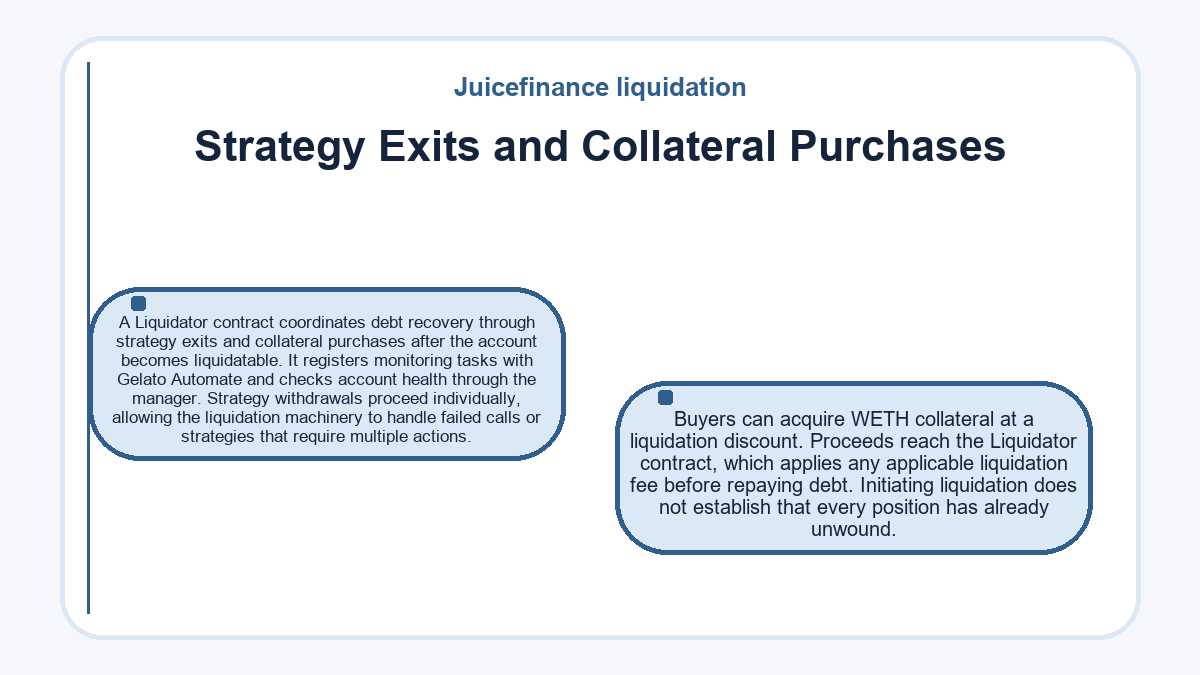
A Liquidator contract coordinates debt recovery through strategy exits and collateral purchases after the account becomes liquidatable. It registers monitoring tasks with Gelato Automate and checks account health through the manager. Strategy withdrawals proceed individually, allowing the liquidation machinery to handle failed calls or strategies that require multiple actions. Buyers can acquire WETH collateral at a liquidation discount. Proceeds reach the Liquidator contract, which applies any applicable liquidation fee before repaying debt. Initiating liquidation does not establish that every position has already unwound.
Liquidation Fees, Debt Shortfalls, and Lender Losses
Liquidation charges reduce the recovered USDB that can repay the loan. The documented liquidation fee is 5% of proceeds, waived when liquidation leaves bad debt for lenders. JuiceGovernor configures protocol fees, so the applicable setting governs the actual charge. A collateral discount compensates collateral buyers through pricing; the liquidation fee directs part of recovered proceeds to the protocol.
A shortfall arises when recovered assets cannot repay the account’s debt. The borrower can lose deposited collateral and assets acquired with borrowed funds. The risk also reaches the lending pool: unrecovered debt can produce losses shared among lenders in proportion to their deposits. Recovery depends on the value that the account’s assets can realize. External strategy failures and incorrect pricing can worsen losses.
An account with unrecovered debt can remain Liquidating even when the system no longer detects it as liquidatable.
Account Status and Recoverable USDB
A partially repaid USDB loan can leave its borrowing account in the Liquidating state. The debt record, remaining strategy assets, and WETH collateral balance describe different parts of that recovery. Full debt settlement and Healthy status distinguish a claimable surplus from funds still committed to recovery.
- While normal controls remain open, adding WETH or repaying USDB can improve the account’s margin.
- Once Liquidating starts, the repayment exception remains available while ordinary collateral and strategy actions close.
- With debt still outstanding, a reduced loan balance does not establish the completed return to Healthy status.
- If recovery leaves bad debt, the owner still owes the remainder even after automated recovery stops.
- When debt has fully cleared and the account returns to Healthy, its owner can claim remaining USDB.
Post-event reconciliation accounts for the collateral that buyers acquired, the USDB that strategy exits recovered, the protocol fee, and the debt that those funds repaid. Collateral purchases reduce the WETH balance that remains available to its owner. A remaining USDB balance belongs alongside the outstanding debt and account status, because liquidation proceeds first fund any applicable fees and repayment.
The LRT-backed WETH borrowing route uses liquid restaking tokens as collateral and WETH as its loan asset. Its debt denomination must remain separate from this USDB settlement flow. For the WETH-backed USDB account, the owner’s surplus claim concerns USDB that remains after full debt repayment.
Questions and answers about Juicefinance liquidation
Can I Restrict Repayment to the USDB That I Just Deposited?
The documented repay function uses the account’s entire available USDB balance to settle its debt, leaving any excess. It does not limit repayment to the newest deposit. Existing USDB in the credit account therefore contributes to the same repayment. The amount of debt that the function clears cannot exceed what the account owes, and a wallet balance outside that account remains separate.
Why Can the Outstanding Loan Grow Between Account Updates?
Borrowing interest accrues while the loan remains open. The lending pool updates its debt index to account for accrued debt before lending-pool actions. Its variable borrowing rate depends on pool utilization, so an earlier debt reading can become outdated. The outstanding debt at settlement matters even when the collateral token quantity has not changed.
Does a Plain Lending Deposit Face the borrower’s Margin Liquidation?
A plain USDB or WETH lending deposit does not create a collateral-backed borrower loan and does not face that loan’s account-margin liquidation. Lenders still carry recovery risk. If borrower liquidation leaves bad debt, the lending pool can pass losses to lenders in proportion to their deposits.
Could Incorrect Oracle Data Trigger Liquidation With Unchanged Collateral Holdings?
Incorrect oracle data can distort the manager’s asset valuations and therefore its liquidation assessment. The quantity of WETH collateral can remain unchanged while the price feed changes its counted USDB value. The liquidation test uses the account’s combined valuation against debt, so an unchanged token quantity alone does not establish sufficient margin.
Will a bad-debt Fee Waiver Remove the Remaining Loan Balance?
The documented bad-debt fee waiver concerns the liquidation charge, while unpaid loan debt remains outstanding. An account that cannot repay its debt can remain Liquidating after automated recovery stops. Restoring Healthy status still requires the owner to settle the unpaid debt.
Last updated: